
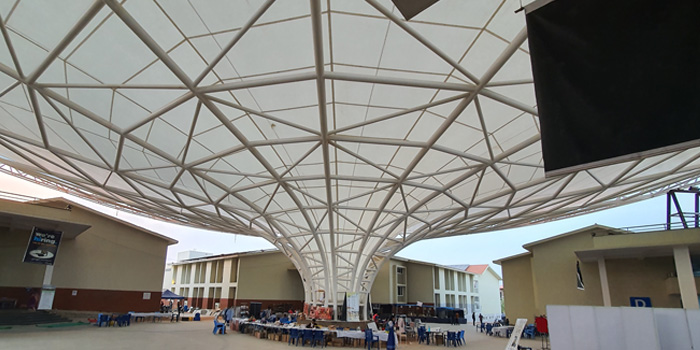
- Inverted Cone Tensile Structure
Inverted Cone Tensile Structure
Inverted cone tensile structures are unique, fabric-covered buildings that provide excellent and stunning structural integrity and aesthetic appeal. It collects 100% roof water and can divert to rainwater harvesting sumps. Inverted cone tensile structures are large, conical-shaped structures that can be used for patios, walkways, and event spaces. They are made from tensile fabric that is durable, weather resistant, and elastic. The material used can affect the structure's properties, for example, ETFE film gives the structure UV resistance and greenhouse properties, while fiberglass coated Teflon makes it more resilient to weather.
Here are some of the features of inverted cone tensile structures:
Aesthetic look: The conical shape of the structure creates an eye-catching look.
Easy to install and maintain: These structures easy to install and require low maintenance.
Durable: Inverted cone tensile structures are extremely durable.
Allow natural light to filter through: These structures allow natural light to filter through, creating a visually striking canopy.
Can be used in a variety of settings: These structures are ideal for patios, walkways, and large event spaces.
Benefits
High structural stability
Resistance to wind and snow loads
Natural light and ventilation
Energy efficiency
Low maintenance
Unique architectural design
Cost-effective
Design Characteristics
Inverted cone shape
Tensioned fabric membrane
Central support column or mast
Radial cables and tensioning system
Foundation system (shallow or deep)
Fabric Materials
ETFE (ethylenetetrafluoroethylene)
PTFE (polytetrafluoroethylene)
PVC (polyvinyl chloride)
Polyester- PES
Frame Materials
Steel (galvanized or stainless)
Aluminum
Fiberglass
Wood (treated or untreated)
Applications
Public spaces (parks, plazas)
Commercial buildings (entrances, atriums)
Residential buildings (courtyards, pool areas)
Recreational facilities (stadiums, arenas)
Event spaces (festivals, concerts)
Airports Arrival and Departure drop off and pick up areas.
Key Components
Fabric membrane
Central support column or mast
Radial cables and tensioning system
Anchoring system
Foundation system (shallow or deep)
Software for Design and Analysis
Autodesk Revit
Rhino and Grasshopper
SketchUp
STAAD
ANSYS
LS-DYNA
Technet Easy Software- membrane analysis
DlubalRstab Software – steel analysis
Industry Standards
ASTM (American Society for Testing and Materials)
ISO (International Organization for Standardization)
ASCE (American Society of Civil Engineers)
IFAI (Industrial Fabric Association International)
AISC (American Institute of Steel Construction)
Euro Code-03
IS Codes (Indian Standard Code) – BIS- Bureau of Indian Standards
Case Studies
Delhi International Airports (INDIA)
Mumbai Airport terminal -01 (INDIA)
Chennai International Airport (INDIA)
Rajkot International Airport (INDIA)